Wilmslow’s Second World War dead: a new record

Yesterday was Remembrance Sunday. For anyone who would like to know more about the people named on Wilmslow’s Second World War memorials, the Wilmslow Historical Society has published a full record of them.

Greater Love Hath No Man, compiled by David Briggs, runs to more than 230 pages. It covers the names on the main memorial by St Bartholomew’s, the Handforth memorial, and those at St John’s Lindow, the United Reformed Church, Wilmslow Methodist, St Philip’s Alderley Edge, Styal, Dean Row and Water Lane Chapels, and Wilmslow Cemetery. It also adds a few people with Wilmslow connections who are not named on any local memorial.

Each entry begins with the Commonwealth War Graves Commission details. These are followed by what could be found in regimental, squadron and ship histories and in The Alderley and Wilmslow Advertiser, which often printed an address, a pre-war occupation and a photograph.

Over half of those named served in the RAF, most of them in Bomber Command. Others served at sea, or in France, North Africa, Italy, the Far East and north-west Europe. Chief Wren Phyllis Bacon, aged 21, died when the SS Aguila was torpedoed in August 1941. May Brandon, a nurse from Dean Row, was killed when a parachute mine fell on the Barrowmore sanatorium near Chester in November 1940. One Alderley Edge family lost three sons in 1943. Nearly a quarter of the deaths were in training or accidents, and several came in the last days of the war or after it had ended.

Some entries are much fuller than others, and one man, John Goddard, a civilian flight engineer, remains largely unidentified. If you have photographs, letters or other information about anyone in the record, or spot an error, please contact the Wilmslow Historical Society at wilmslowhistoricalsociety@gmail.com.

We will remember them.

Note: This is a big file (14.3Mb, 233 pages) so be aware if downloading on your phone.

Clegg’s Department Store

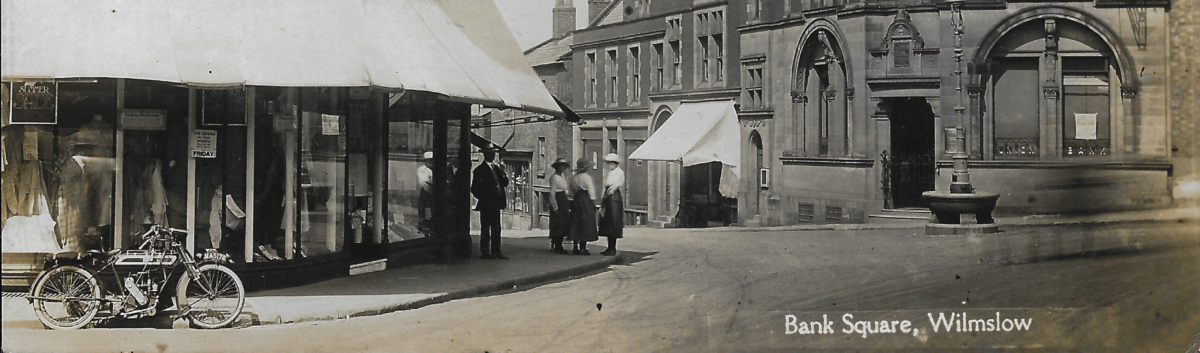
For almost a century, Clegg’s was one of the landmarks of Bank Square. Walter Shields Clegg, born around 1848 in Oldham, opened the store in January 1881 as an outfitter and soft furnisher. Over time it added in-house tailoring, a restaurant, a furniture department, and a funeral business. The building also formed the backdrop to town life, with the Wakes Day parade (1907), carnivals, and remembrance parades passing its doors.

Cllr Jon Kelly has put together the store’s history from photographs, documents and the memories of local residents. The store closed in the 1970s. The funeral business was taken over by Arthur R Slack Ltd. The page traces what happened to the site afterwards and includes about sixteen photographs, from the early 1900s to the present day.

December 1914 – Silent Night

By Christmas 1914 the war of movement had stalled, and in the trenches of Flanders some lines were only about 50 yards apart. Jon Armstrong and Alan Cooper tell the story of the unofficial Christmas truce. It began in the German trenches with lit tree decorations and carols. Soldiers from both sides then met in no man’s land, swapped food and tobacco, buried their dead and, in places, played football.

The article follows men of the Cheshire Regiment who were there, among them Ernie Williams, a Territorial with the 6th Cheshires, who recalled the football in a 1983 TV interview. It also remembers a Wilmslow man who spent that Christmas far from the Western Front: Private Francis Shaw, a Wilmslow-born Territorial with the 1st/8th Manchester Regiment, died in Egypt on 18 December 1914, probably of disease. The truce did not last, and the article closes with how it has been remembered since.

December 1914 – Silent Night

Wilmslow in WW2 : VJ DAY

For many Wilmslow families, the war did not end in May 1945. Cheshire men were still fighting in the Far East, with the Fourteenth Army in Burma and with the Royal Navy’s British Pacific Fleet. This article remembers some of them. The thread running through it is the memories of Nora Mottram (born 1922 on Lacey Green Road; worked on the railways at Victoria Station, Manchester), who later married Reg Fox, a petty officer on HMS Montclare. Around her story are the local men who came home: a former prisoner of war, a Styal Cottage Homes boy who fought in Burma, and a councillor whose ship was part of the planned invasion of Japan. Jon Kelly also traces the British Pacific Fleet’s operations, from the air strikes on Sumatra to the attacks on the Japanese home islands.

Wilmslow in WW2 : VJ DAY

Wilmslow in WW2 : VE DAY

This is how the Knutsford Advertiser of 11 May 1945 reported Wilmslow’s celebrations at the end of the war in Europe. Monday was a day of waiting, with most residents stayed indoors listening to the wireless for news. Then on Tuesday 8 May, VE Day itself, the news came through and the bonfire in the Carrs was lit. The streets were hung with bunting, flags and fairy lights, many of them in the shape of a “V”, and the churches and chapels held thanksgiving services. On Moor Lane, an effigy of Hitler was burnt at a children’s bonfire, which was followed by sweets, ice cream and a neighbours’ tea party. The report is reproduced in full, transcribed by Jon Kelly.

Wilmslow in WW2 : VE DAY

Remembering the Korean War

The Korean War is often called the forgotten war, but some of the men who served in it still meet to remember it. Jon Kelly and Alan Cooper talked with three Fleet Air Arm veterans. One is Bernie Cohen, who served on HMS Glory, which carried aircraft for strikes on the enemy. The other two are Wilmslow men: Mike Ramsey, a National Serviceman who took part in collecting Grumman Avenger torpedo bombers in Norfolk, Virginia, for transport to Korea, and Derek Pay, an engineering Artificer who was later drafted to HMS Theseus after its Korean deployment.

Their memories sit alongside an account of the war itself and of the aircraft carriers whose Sea Furies attacked bridges, airfields and railways. The article also covers the medals and recognition the veterans received, including thanks from the Korean Government. It closes with the war’s memorials and a Cheshire connection at HMS Blackcap, a former RAF fighter station about 3 miles southeast of Warrington.

Remembering the Korean War

Lindow Moss and the Wilmslow Rifle Volunteers

Local stories have long placed a Victorian rifle range on Lindow Moss, and street names such as Riflemans Close and Alma Lane hint at it. Cllr Jon Kelly sets out what the records actually show. After the Crimean War a volunteer movement grew up across the country, and the 27th Cheshire (Wilmslow) Rifle Volunteer Corps, formed 5 March 1860 under Captain Edward Hyde Greg. The article follows the Corps through its drill, competitions and changes of name, and through the safety worries that led to the Lindow range closing and to the failed 1903 “safety range” plan. With photographs, maps, the Captain’s muster notebook and Bill Flentje’s research on how the range worked, it is the fullest account so far of a part of Wilmslow’s history that left little behind but its names.

Lindow Moss and the Wilmslow Rifle Volunteers

The Victorian Charm of Dean |Row

On 23 October 1963 Hilda Briggs gave a talk to the senior class at Dean Row Primary School about the hamlet as she had known it. She was born Hilda Hankinson in Dean Row in 1882, into a family who had run the local tannery for three generations. She left as a child, came back to Wilmslow in the 1920s, and lived there until her death in 1971.

Her talk draws on family memory as well as her own. It covers the hamlet’s early landholding, the Unitarian Chapel of 1689 and the Methodist Chapel, the tannery, the brick works and the cottage trades, and the British School of 1861. She also remembers the Unicorn Inn, where the week’s news was read aloud, Penny Readings, Boon Day and Bonfire Night on the green. Some local characters appear too, among them “Pig-Nellie” and the owner of “Button Hall”.

Her grandson, David Briggs, transcribed the talk for the Society in 2023 from papers kept in the family. He added footnotes bringing dates up to the present and pointing to the 1841 tithe maps, the 1898 Ordnance Survey and other sources.

The Victorian Charm of Dean Row